
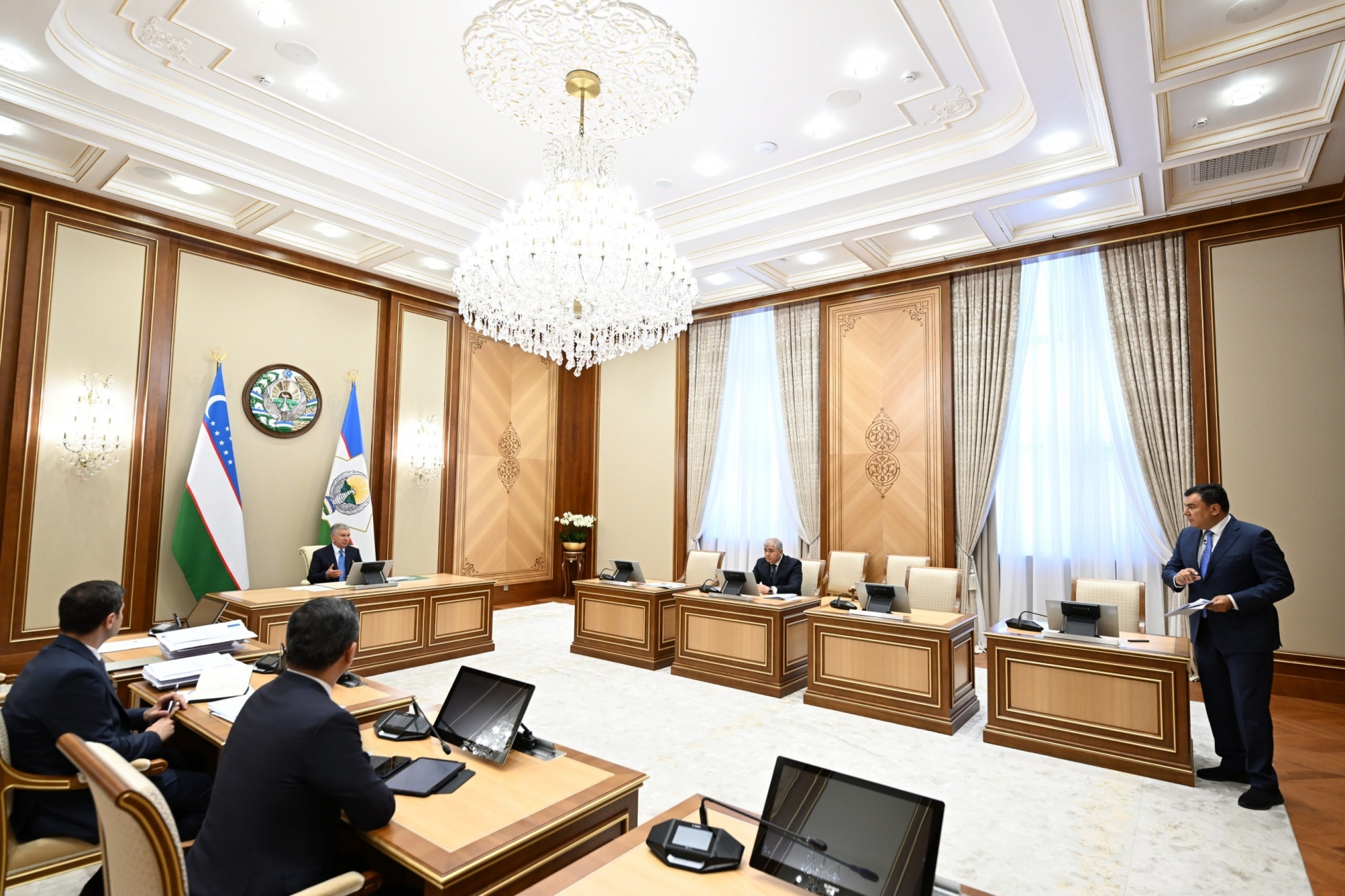
President Shavkat Mirziyoyev reviewed proposals on combating desertification and developing a desert economy, as well as implementing green city principles.
Climate change, the depletion of water resources, land degradation, and desertification are becoming pressing environmental challenges across the region. These processes have a direct impact on agricultural sustainability, food security, public health, and regional economic development.
Around 80 percent of Uzbekistan’s territory consists of desert and semi-desert zones. Soil salinization, shifting sands, dust storms, and dry winds pose a serious threat, particularly to the Republic of Karakalpakstan, the Bukhara, Navoi, and Khorezm regions, as well as certain districts of the Kashkadarya, Surkhandarya, and Jizzakh regions.
The drying of the Aral Sea has further intensified these processes. The Aralkum Desert has formed on the dried seabed, while salt and dust carried into the air spread across vast areas. In this regard, consistent efforts are underway in the Aral Sea region to establish green cover through the planting of saxaul and other desert plants. In recent years, more than 2 million hectares of new forest plantations have been established on the dried bed of the Aral Sea.
Large-scale efforts are also underway under the nationwide “Yashil Makon” project. More than 1 billion tree and shrub seedlings have been planted across the country, increasing green coverage from 8 percent in 2020 to 14.3 percent by 2025. In the Aral Sea region, as well as border and arid areas, efforts are continuing to establish green cover and protective forest belts.
During the presentation, President Shavkat Mirziyoyev reviewed proposals to advance the country’s efforts to combat desertification during 2026–2030. In particular, plans call for the establishment and restoration of forests across 1.27 million hectares, along with the planting of protective forest belts on 16,000 hectares in desert, mountainous, and foothill areas.
It was proposed to create green cover across 10,000 hectares in the Surkhandarya region, establish an 84-kilometer “green wall” in the border areas of the Syrdarya region, plant trees and shrubs using the terracing method in mountainous and foothill areas, and pilot modern agrotechnologies on degraded land.
The Head of State emphasized that desert areas should be viewed not only as an environmental challenge but also as a source of new economic opportunities. To this end, the importance of developing a “desert economy” approach was noted, including the creation of sustainable sources of income on undeveloped and saline lands, the establishment of seed production facilities and nurseries for desert plants, the cultivation of halophytes, increased pasture productivity, and the expansion of animal husbandry, ecotourism, and scientific research.
It was proposed to establish nurseries for desert plants in Karakalpakstan, conduct scientific expeditions to the dried bed of the Aral Sea, develop pistachio plantations in the Babatag area using modern methods, and expand the network of halophyte gardens. The establishment of a regional bank of drought-resistant plants and seeds, as well as the attraction of international funding and private investment, was also discussed.
Particular attention was also paid to strengthening environmental cooperation with the Central Asian countries. It was noted that desertification and land degradation are challenges that know no borders; therefore, a unified regional approach, scientific cooperation, data exchange, and technology transfer are essential to addressing them.
In this context, initiatives were put forward to expand the activities of the Central Asian Regional Research Center for Combating Desertification and Developing the Desert Economy, increase the number of practical projects under the regional “Green Shield” program, and develop a strategy for combating desertification untill 2040.
Taking into account Samarkand’s historical and cultural heritage, its role on the Great Silk Road, its potential as a center of international tourism, its strategic geographical location, and its existing water and transport infrastructure, the city is planned to be transformed into a model of an environmentally sustainable, climate-resilient, and modern green city in Central Asia.
In this regard, the “Green Samarkand” model, aimed at ensuring the environmental sustainability of cities, was reviewed during the presentation.
Under this model, specific environmental targets are planned to be achieved in Samarkand by 2030. These include preventing the emission of 51.2 thousand tons of atmospheric pollutants, reducing PM2.5 and PM10 concentrations by 50 percent through the installation of dust and gas cleaning equipment at industrial and energy facilities, reducing construction dust by 80 percent, cutting vehicle emissions by 50 percent, halving the volume of waste sent to landfills, and increasing the share of green spaces in populated areas to an average of 30 percent.
To implement the project, a “Yashil Samarkand” Project Office will be established with the participation of the Samarkand Regional Administration and the National Committee for Ecology and Climate Change. The office will coordinate, within a unified framework, activities in the areas of urban planning, ecology, transport, construction, tourism, industry, and public utilities.
A special environmental and urban planning regime will be introduced in Samarkand, establishing green building requirements for new and reconstructed facilities. Under these requirements, the use of energy- and water-saving technologies, the introduction of waste sorting and recycling systems, improved resource efficiency, and the prevention of the commissioning of facilities that do not meet environmental standards will become standard practice.
In the transport sector, a transition to an environmentally friendly mobility model is planned for Samarkand. To this end, 50 modern high-capacity electric buses will be purchased, 150 new traffic lights will be installed at intersections, and measures will be taken to complete the transition of public transport and taxi services to electric vehicles by 2030. In addition, a “Park & Ride” system will be introduced, green tourist zones with pedestrian priority will be created, and private vehicle access to the city center will be gradually reduced.
To develop water and green infrastructure, at least four artificial lakes and reservoirs will be created in Samarkand, along with at least one in each of the region’s district centers. In Samarkand, 10 new fountains will be built, while the infrastructure of existing fountains will be modernized. In addition, an irrigation canal system with a total length of 319 kilometers will be constructed and restored.
To establish a protective green infrastructure around the city, a 102.7-kilometer green belt covering 3,532 hectares will be created along the New Grand Ring Road. The green belt is intended to reduce dust and hot air flows, improve air quality, create a natural protective zone around the city, and strengthen climate resilience.
In terms of urban planning, the development of “Green City Samarkand” across an area of 300 hectares is envisioned. The area will accommodate residential, office, service, tourism, and public infrastructure facilities built in accordance with international green city standards.
To reduce the environmental impact of industrial facilities, best available technologies, “Zero Visible Emission” systems, and digital environmental monitoring will be gradually introduced in the green industrial zone. Green belts will be established around existing industrial zones, and measures will be taken to relocate eight Category I and II industrial enterprises that pose a serious threat to public health outside the city.
In the field of waste management, a system for waste sorting, recycling, and reducing the volume of waste sent to landfills will be introduced in line with the “Zero Waste Samarkand” principle. An information system for the digital mapping and photo and video recording of illegal waste disposal sites will also be launched.
In the area of climate policy, carbon emission reduction targets for 2030 and 2035 will be developed for Samarkand, along with a “Carbon Neutral Samarkand” roadmap. In addition, the “Green Samarkand Climate Finance Facility” platform for financing green and climate projects and the “Green Samarkand Dashboard” digital platform for the transparent publication and monitoring of results will be launched.
In tourism and biodiversity, the “Green Samarkand” brand, the “Green Hotels Samarkand” rating system, the “Samarkand City Biodiversity Index” methodology, the “Urban Biodiversity Samarkand” pilot project, and the “Let’s Preserve Biodiversity” volunteer program will be introduced. As a result, Samarkand will become a center for ecotourism, green investment, and sustainable urban solutions.
Overall, the project will establish the organizational, financial, and practical foundations for positioning Samarkand as the “Capital of Green Investment and Innovation of Central Asia.”
President Shavkat Mirziyoyev approved the proposals and gave the responsible officials relevant instructions on combating desertification, the rational use of land and water resources, strengthening environmental requirements in urban planning, and creating a healthy environment for the population.