
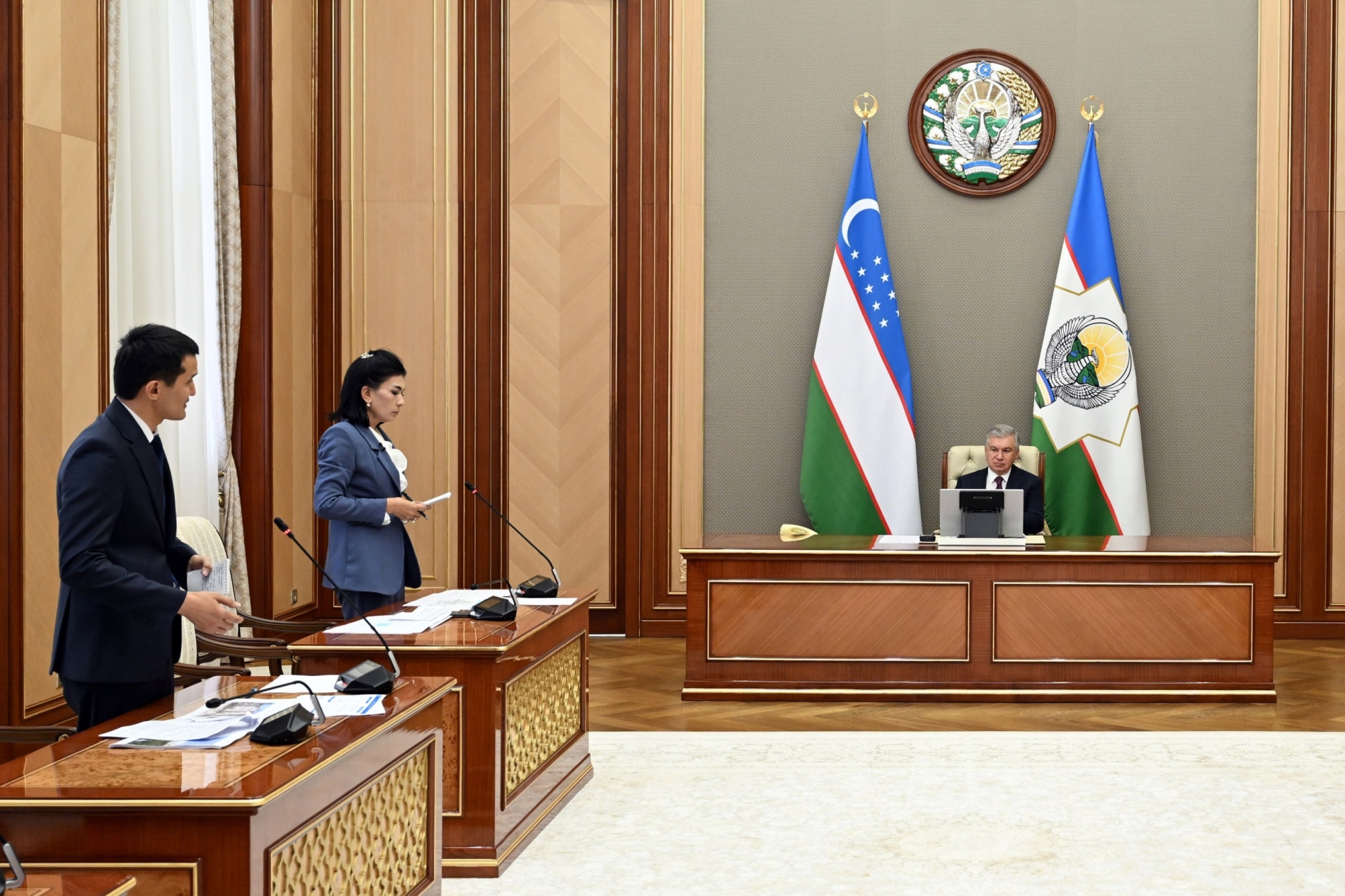
President Shavkat Mirziyoyev reviewed a presentation on the modernization of the Nukus city boiler house using cogeneration technologies.
Ensuring a stable heat supply to residential buildings and social facilities during the autumn-winter period, together with the introduction of energy-saving technologies into the system, is an important task.
At present, 47 apartment buildings in Nukus are connected to the centralized heating system, while 270 buildings use local heating systems. Apartments in the remaining residential buildings are heated using various makeshift devices. In addition to consuming large amounts of energy, such methods pose a serious threat to people’s health and safety.
The city’s central boiler house was built in 1976 and now primarily serves social facilities. Its equipment is physically worn and technologically outdated, while its energy efficiency remains low.
To produce one gigacalorie of thermal energy, the existing boiler house consumes around 153 cubic meters of natural gas and 30 kilowatt-hours of electricity. Its actual capacity is only 1.6 gigacalories per hour.
The presentation included a project to modernize the boiler house through a public-private partnership and the introduction of cogeneration technologies.
Cogeneration enables the simultaneous production of electrical and thermal energy from a single fuel source. This ensures more efficient use of resources, reduces production costs, and lowers harmful emissions into the environment.
Under the project, a modern complex will be constructed with a thermal capacity of 34.4 gigacalories per hour and an electrical capacity of 21.5 megawatts.
The project also provides for the laying of 28 kilometers of heating networks, the installation of 189 individual heating substations, the rehabilitation of the internal heating systems of apartment buildings and social facilities, and the modernization of the necessary gas and power infrastructure.
During the first stage, centralized heating will be provided to approximately 6,000 apartments in 136 apartment buildings, home to around 23,000 people, as well as 40 social facilities. In subsequent stages, all apartment buildings and social facilities in Nukus are planned to be connected to the centralized heating system.
Over $20 million in foreign direct investment will be attracted for the implementation of the project’s first stage. The complex is scheduled to become fully operational in February 2028.
As a result of the modernization, the boiler house’s efficiency will increase from 80 to 91 percent. Thermal energy production will increase several dozenfold, while the facility will be capable of generating up to 172,000 megawatt-hours of electricity annually.
The project will save 12.2 million cubic meters of natural gas each year. Harmful atmospheric emissions will also be significantly reduced.
The new complex will create 19 jobs. Employees’ qualifications will be upgraded in the application of modern technologies and equipment maintenance.
The Head of State emphasized that the foremost priority in implementing the project is to provide the population with a stable, safe, and high-quality heat supply, while ensuring that construction is completed on schedule and to a high standard.
Responsible officials were assigned specific tasks to coordinate the implementation of the project and ensure the timely resolution of all infrastructure-related issues.
The presentation also included proposals for the subsequent modernization of boiler houses in the cities of Bukhara, Samarkand, Urgench, and Zarafshan, drawing on the Nukus experience and incorporating cogeneration and trigeneration technologies.