
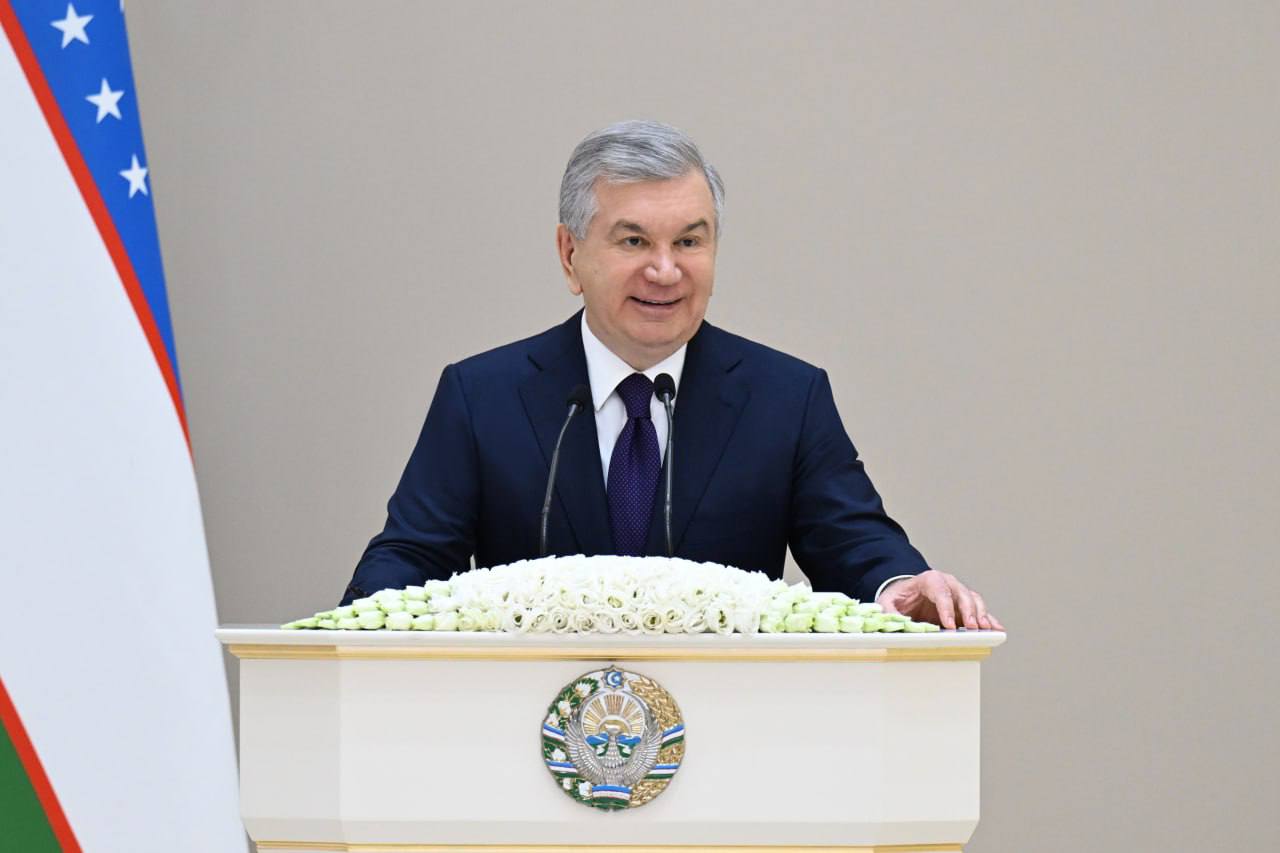
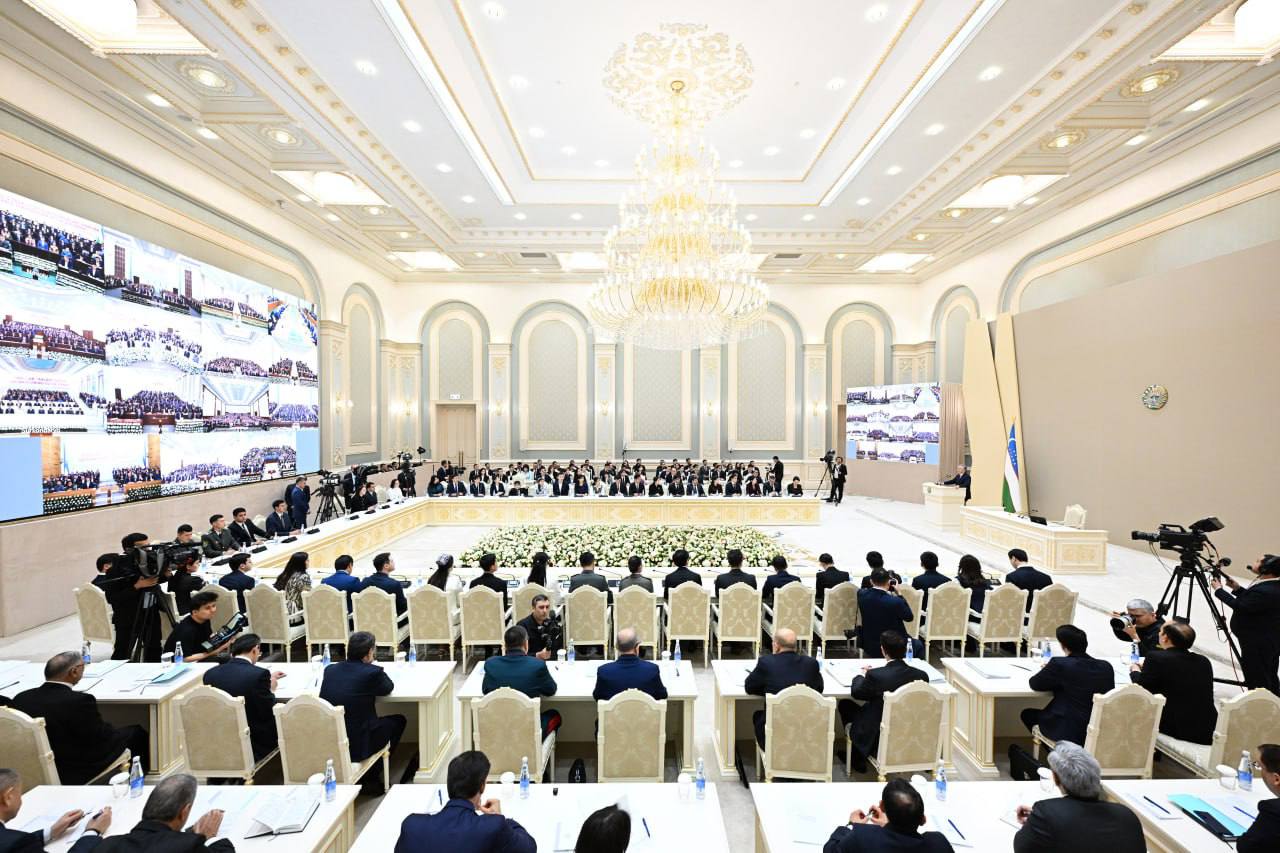
A dialogue between President Shavkat Mirziyoyev and youth took place at the Kuksaroy residence.
More than 60,000 young people participated in the meeting via studios in Karakalpakstan, across the regions, and in the city of Tashkent.
Warmly welcoming the participants, the Head of state noted that the country’s more than 22 million young people represent a powerful economic, social, and political force. He emphasized that leaders at all levels must intensify efforts to equip youth with foreign language skills and professions, engage them in sports, support their ideas, projects and startups, and create conditions for sustainable employment and a decent income, ensuring that no young person is left without attention or support.
Thanks to the opportunities created in recent years, young people of our country have secured 66 gold, 147 silver and 221 bronze medals at international science Olympiads. The number of students studying at prestigious universities such as Harvard, Yale, Princeton, Columbia and Cornell has exceeded 500, while more than 3,500 young men and women have been admitted to the world’s top 100 universities. Sixty-three startup projects launched by young compatriots have already entered the markets of the United States, South Korea, the United Kingdom and the United Arab Emirates. Our athletes have won 720 gold, 671 silver and 854 bronze medals in international competitions. Today, 35 percent of the country’s business representatives are young entrepreneurs.
In this context, Uzbekistan’s recognition as one of the most dynamically developing countries in the Global Youth Development Index represents a natural outcome of these efforts. The forthcoming opening of the headquarters of the World Youth Movement for Peace in Tashkent, as well as the hosting of the 12th Global Conference of Members of the Youth Parliament, the “Take Off” international startup summit, and the 46th World Chess Olympiad in Samarkand, will further reinforce this standing.
Noting that 600,000 young people enter the labor market each year—and that this figure will reach 1 million by 2030—the President emphasized that creating conditions for young people to secure employment aligned with their interests and abilities is a task of paramount importance.
According to a survey among youth, one-third expressed a desire to become entrepreneurs.
It was noted that last year, $400 million was allocated to banks and the Agency for Youth Affairs to ensure youth employment, and through the “Yoshlar Biznesi” and “Kelajakka Qadam” programs, 15,000 young people launched their own businesses, employing 50,000 people.
To continue this work, an additional $200 million has been announced to support youth entrepreneurship.
At the same time, financing opportunities will be expanded: the loan amount for young self-employed individuals will increase from 100 million sums to 300 million sums. Projects by young entrepreneurs can receive up to 10 billion sums in loans. Investments of up to $100,000 will be permitted in innovative startups. Tailored financing packages will also be introduced for young people seeking to open franchise branches of local brands that have created more than 1,000 jobs in the service and catering sectors.
Starting this year, the “Kelajak Tadbirkori” program will be launched, providing loans to young entrepreneurs for up to seven years at an annual interest rate of 15 percent.
In particular, unsecured loans of up to 20 million soums will be available to self-employed young people, up to 300 million soums to those starting their own businesses, up to 2 billion soums to entrepreneurs seeking to expand their operations, and up to 10 billion soums to those who have employed at least five graduates.
It was also noted that 30 percent of young people starting a business face difficulties due to a lack of entrepreneurial skills. In this regard, youth business incubators will be established in each region to provide comprehensive services in entrepreneurship training, assistance in transforming ideas into viable businesses, accounting and banking services, marketing guidance, and access to domestic and international markets.
Noting the readiness of a number of prestigious foreign universities to cooperate in delivering entrepreneurship education to young people based on advanced international experience, a decision was made to launch the “Yangi avlod tadbirkorlari” program, under which at least 40,000 young people are expected to receive training in business skills. The projects of the top 1,000 participants who successfully complete the program will be provided with a 7 percent loan of up to 200 million soums for a term of three years.
The “Young Entrepreneurs” competition will be held annually, with up to 1 billion soums from the “Yoshlar Ventures” fund allocated to form and establish the 100 best projects as brands.
From March 1, expenses incurred by aspiring young entrepreneurs for public services related to infrastructure connections will be covered by the State Fund for the Development of Youth Entrepreneurship.
The task has been set to expand the experience of the “Share your opinion (Voice Up)” inclusive social initiatives camp – to hold similar events in each region and cover 1,000 young participants, and subsequently organize an International Inclusive Youth Camp in Samarkand featuring the best initiatives.
As part of the “Growth and Development (Upshift)” project, competitions will also be held this year in the fields of media, design, craftsmanship, manufacturing, and innovation. Two billion soums will be allocated to finance the 40 best startups projects.
Tasks have been defined to update educational programs in technical schools to meet employers’ requirements, expand the coverage of dual education, and improve the material and technical base.
Technical schools, like universities, will be permitted to establish spin-off companies, with up to 1 billion soums allocated to support student startup projects. Starting this year, students of technical schools will also have the opportunity to work abroad for up to six months under the “Work and Travel” programme to earn additional income, with participants eligible for loans to cover travel expenses.
It was noted that the support mechanism for young people obtaining foreign language certificates is proving effective: the number of certificate holders has exceeded 600,000, and a corps of 72,000 instructors proficient in foreign languages has been formed. The number of private training centres has tripled, surpassing 38,000.
The initiative to establish an Association of Private Training Centers was supported. Entrepreneurs who lease premises to member centers of the association will be exempt from tax on rental income and profit tax. The practice of sending teachers from these centers for internships at leading educational institutions will also be introduced.
Within the “Ko‘mak” program, interest-free loans of up to 300 million soums are planned to expand the activities of foreign language training centers in remote and hard-to-reach areas. Training centers in these regions will pay a social tax of 1 percent, while the income tax rate for teachers will be reduced to 7.5 percent, compared to the current 12 percent.
Additional benefits have been introduced for training centers that provide free education to young people from low-income families at the local level: they will be exempt from land and property taxes, 50 percent of their utility costs will be compensated, and the income and social taxes paid for teachers will be reimbursed in the form of cashback.
Special attention was paid to the development of volunteer activities. It was noted that thanks to the established legal framework, the number of volunteers in the country has increased fivefold to over 100,000 people, involved in the fields of ecology, medicine, education, and emergency assistance.
To further develop the volunteer movement, it is planned to establish a Board of Trustees, and under the Agency for Youth Affairs, a Volunteer Support Fund. Annually, 20 billion soums will be allocated to the fund from the state budget, along with an additional three billion soums from local budgets. These resources will be used to provide grants of up to 100 million soums for volunteer projects, and a point-based system will be introduced through a “social activity card.”
The meeting also addressed issues related to supporting young families and promoting a culture of reading.
It was noted that under the mortgage program for young families, the portion of the loan interest rate exceeding 14 percent will be compensated from the state budget.
Through the Fund for the Development of Reading Culture, it is planned to place creative orders with the most talented writers, with a payment of 20 million soums per month for one year, as well as to compensate for 50 percent of the costs of translating and publishing the best examples of foreign literature into Uzbek and national literature into foreign languages.
A task was set to compile a collection of the 100 best works before the start of the new academic year and distribute it to all schools and technical colleges, as well as to award the most active student readers with a prize of 10 million soums.
For entrepreneurs opening libraries, book cafés and bookstores with monthly sales of 10,000 books, a mechanism has been introduced to provide preferential loans of up to 1 billion soums for a term of three years at an annual interest rate of 7 percent.
The launch of the “Second Chance” project was announced, aimed at accelerating the social reintegration of young people returning from correctional facilities. Under the project, intensive courses lasting eight to twelve months will be organised in programming, web design, computer engineering, other professions and foreign languages to facilitate employment and the attainment of stable income.
At the conclusion of the meeting, the Head of state engaged in a dialogue with young people, listening to their proposals and initiatives across various fields. Reports from responsible officials were also heard at the meeting.