
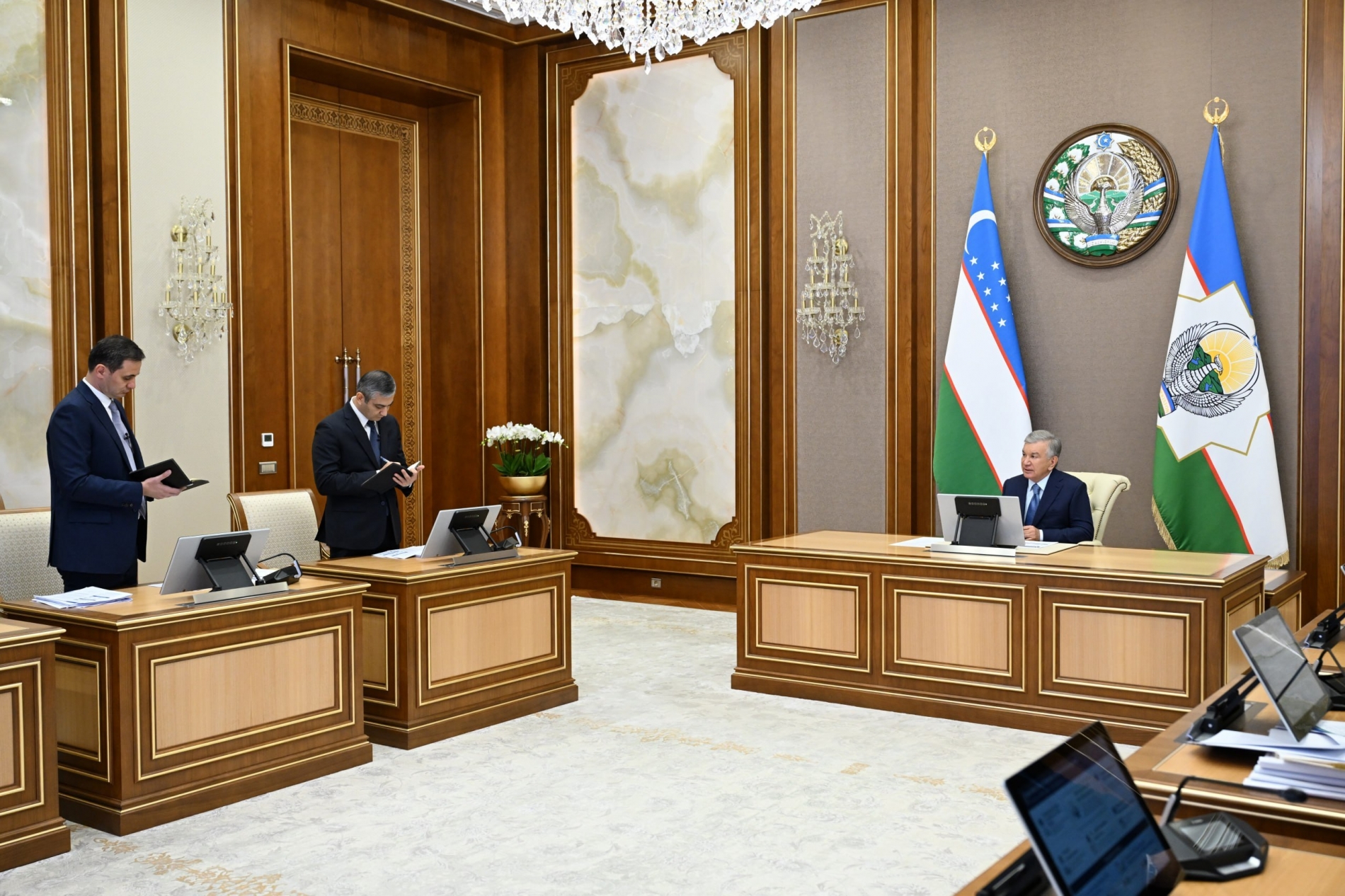

President Shavkat Mirziyoyev reviewed the results of the population and agricultural census and proposals aimed at accelerating reforms in the national statistical system.
Since 1989, the country’s population has nearly doubled, while the economy has doubled in size over the past eight years. These changes have increased the need for accurate and reliable data on the composition and places of residence of the population, land resources, agriculture, and the food supply base.
The Head of State was briefed on the results of the population and agricultural census conducted this year for these purposes.
According to preliminary results, the country’s permanent population stands at 39.047 million. The census identified the places of residence and social status of 810,600 people who had not previously been captured in official statistics.
Compared with existing data, the population was found to be 2.7 percent lower in the Jizzakh region, 1.3 percent lower in the Namangan region, 0.9 percent lower in the Surkhandarya region, and 0.7 percent lower in the Kashkadarya region. The figure remained virtually unchanged in the Bukhara region, while increases were recorded in other regions. In particular, the population of the Tashkent district was found to be 1.6 times higher than previously recorded, while that of the city of Andijan was 15.8 percent lower.
The agricultural census also clarified the boundaries and categories of 985,500 hectares of land that had not previously been reflected in official records. Of these, 789,500 hectares are cropland, 14,100 hectares are greenhouses, 75,300 hectares are orchards, 21,400 hectares are vineyards, and 85,000 hectares are fish-farming ponds.
Thanks to the digitalization of the process, the cost of conducting the census did not exceed 1,500 soums per capita, 15 times lower than in CIS countries. Online census coverage reached 82.3 percent. The entire process was completed in 15 days, placing Uzbekistan second in the world after Canada in terms of the speed of conducting the census.
Based on the census results, continuously updated statistical registers of the population and agriculture will be established. One hundred indicators related to socioeconomic development programs and 50 indicators covering agriculture and cropland will be updated. In addition, national accounts indicators for 2017–2025 will be reassessed.
During the presentation, particular attention was paid to ensuring comprehensive statistical coverage of economic activity. Currently, the unobserved economy accounts for 23 percent, equivalent to 246 trillion soums. In agriculture, it accounts for 60 percent of total turnover.
Of the country’s 15.2 million employed people, the incomes of 6.5 million, or 42 percent, are not fully captured in official records. Many registered small and medium-sized businesses are either inactive or have ceased operations.
This creates an unhealthy competitive environment for businesses that operate in good faith and fully meet their tax obligations. One in every four to five soums of economic turnover remains outside the scope of official statistics. Formalizing these activities could generate tens of trillions of soums in additional budget revenue and help reduce the tax burden in the future.
In this regard, a proposal was approved to conduct a business registration campaign from October 15 to November 30 this year. As part of the campaign, all economic entities operating in the country will be inventoried, and their status, structure, and distribution across sectors of the economy will be clarified. Statistical registers of enterprises and organizations will be updated, creating a reliable basis for conducting sample surveys.
Plans for the development of the national statistical system through 2030 were also reviewed. They envisage reducing the reporting burden on businesses by 20 percent, increasing the number of administrative and alternative data sources by 1.7 times, reducing data processing time by 20 percent, and cutting costs by 25 percent.
To establish a unified approach to data management across the country, it was proposed to create a Data Management Commission comprising representatives of ministries and agencies.
By December 1 this year, the Commission will conduct a comprehensive inventory of data management systems across government bodies and organizations and, by May 1, 2027, approve an action plan for their improvement.
The National Data Platform is scheduled to be launched by July 1, 2027. The platform will integrate data into a unified system, ensure data quality and security, and support the development of analytics and modern digital services. It was also proposed to establish an open data project office and introduce an Open Data Rating for government agencies.
To expand training and research in the field of statistics, it is planned to establish a School of Data-Driven Management. The School will offer educational programs in data management, business analytics, artificial intelligence, data journalism, and visualization for representatives of government bodies, businesses, statistical agencies, the media, researchers, and students.
The use of digital technologies will also be expanded in the national statistical system. By July 1, 2027, statistical data will be published in formats that can be processed by artificial intelligence systems. AI agents will be introduced to compare statistical indicators and conduct in-depth analysis. By the end of 2027, data on population, demographics, agriculture, infrastructure, and regional development will be presented on digital geospatial maps.
At the same time, the seventh round of the Multiple Indicator Cluster Survey is planned for 2027–2028. With the participation of the International Monetary Fund, the national statistical system will also be assessed for compliance with international standards and codes.
During the presentation, the draft national strategy “Statistics Development – 2030” was also reviewed. Its priorities include coordinating the statistical system and ensuring data quality, implementing international standards and methodologies, advancing digital transformation, expanding the use of administrative and alternative data sources, and developing open statistics focused on users’ needs.
President Shavkat Mirziyoyev emphasized that accurate, timely, and reliable statistics are essential for shaping state policy and making informed decisions on the development of regions and industries.
Responsible officials were instructed to thoroughly analyze the census results and make extensive use of them in state programs, conduct the business census effectively, introduce a unified data management system, and consistently develop the national statistical system based on international standards.