
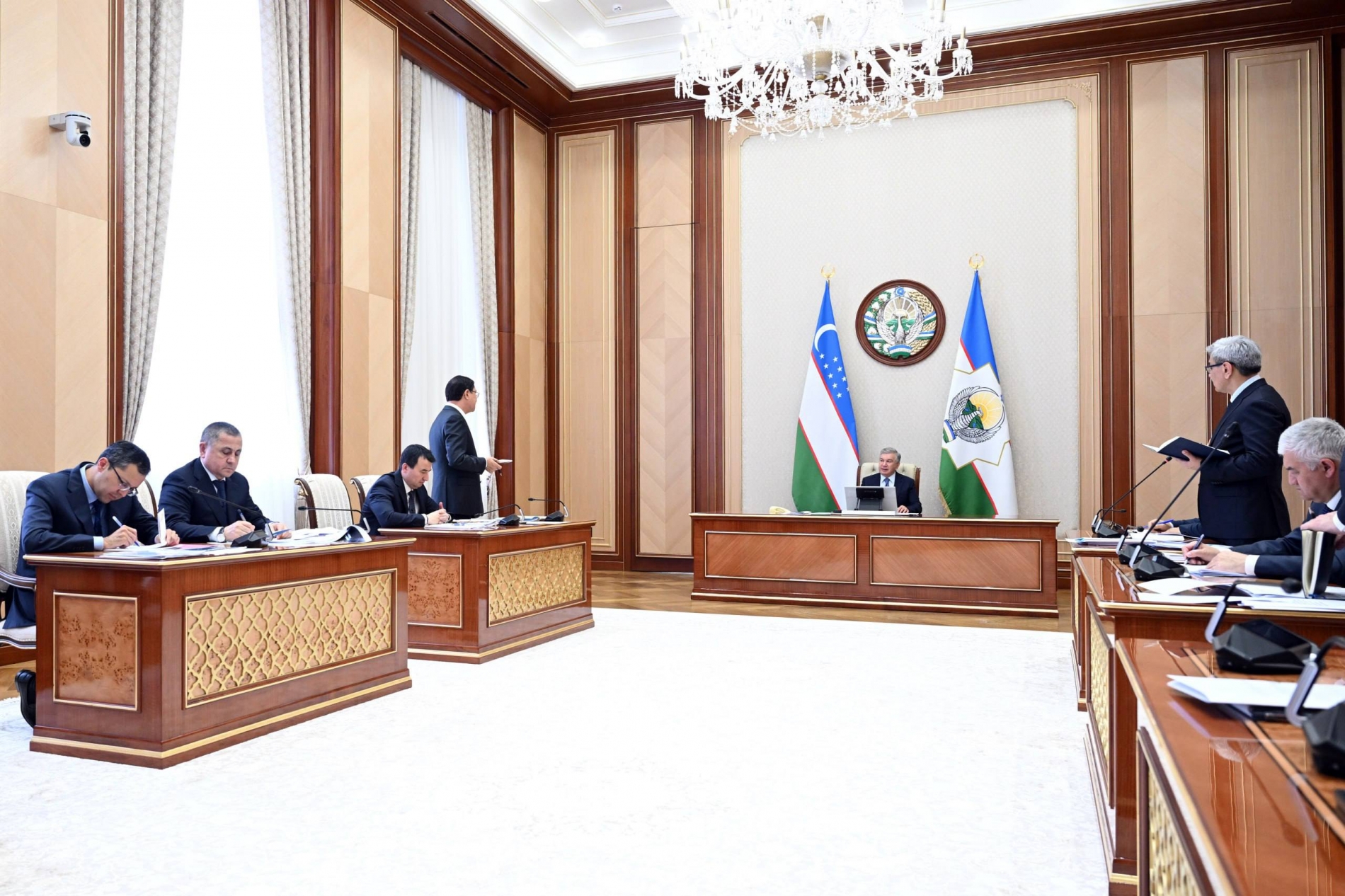
President Shavkat Mirziyoyev chaired a meeting to review the effectiveness of ongoing reforms in the Bukhara region, the efficient use of its economic potential, and further priority tasks.
The Bukhara region possesses significant potential, comparable to other regions, across the spheres of industry, agriculture, services, and tourism. The region is home to two large petrochemical enterprises, with another currently under construction. In addition, the construction of 10 major solar and wind power plants, with a total capacity of 4.5 gigawatts and valued at $5.2 billion, is in full swing.
In 2025, the gross regional product increased by 7.2 percent to 86.6 trillion soums, industrial output grew by 7.1 percent, agriculture by 4.3 percent, while the service sector by 14 percent. The unemployment rate declined to 4.7 percent, and poverty fell to 6 percent compared to 2024.
The meeting reviewed key targets for the socio-economic development of the Bukhara region for 2026. In particular, tasks were set to increase the gross regional product to 102.1 trillion soums and achieve growth of 9.1 percent, raise industrial output by 9.1 percent, agriculture by 5.9 percent, and the service sector by 20.1 percent. Plans also include reducing inflation to 6 percent, decreasing unemployment and poverty levels to 2 percent, and providing income opportunities for 381,500 people.
In this regard, it was noted that targeted measures will be implemented to transform the cities of Bukhara and Kagan, as well as the Alat, Peshku, Karakul, Shafirkan, Gijduvan, and Karaulbazardistricts, into areas free from unemployment and poverty.
The Head of State emphasized that Bukhara is an ancient city with a three-thousand-year history, and that only a few cities in the world possess such a rich cultural heritage and concentration of historical monuments in one place. It was noted that this potential should be leveraged to stimulate economic growth, create new jobs, increase public income, and improve infrastructure.
In the sphere of investment and exports, targets were set for 2026 to attract $3.3 billion in foreign investment, ensure exports of $1.5 billion, and implement investment projects with a total value of $9.2 billion.
Special attention was paid to industrial development. As noted, 61 major projects with a total value of $2.2 billion have been identified in the industrial sector. As a result, it is planned to create 18,000 new jobs, establish 512 new business entities, and increase industrial output per capita from 25.6 million to 29.6 million soums.
In particular, in the Kagan district, plans are in place to establish the production of 80,000 electric and hybrid vehicles per year in cooperation with the Chinese company Leapmotor. The project is valued at $350 million and will create 500 jobs.
Furthermore, plans are in place to implement a $220 million project in the Bukhara district for the production of benzene, toluene, xylene, pentane, hexane, bitumen, and calcium chloride using pyrolysis, expand the production of AI-91 and AI-92 gasoline under an $85 million project in the Karaulbazar district and establish the manufacturing of paper and cardboard products in the Kagan district.
Plans for the production of 100,000 tons of mineral fertilizers per year in the Karaulbazar district and the expansion of gypsum board production in the Kagan district were also discussed.
At the same time, priority areas were identified for establishing new production facilities on vacant land plots across 61 existing industrial zones. In particular, the food and furniture industries will be prioritized in the city of Bukhara and the Bukhara district, leather and textiles in Vabkent, petrochemicals in Kagan and Karaulbazar, pharmaceuticals and food production in Shafirkanand Peshku, and building materials in Gijduvan.
It was noted that the introduction of modern land use and irrigation technologies in agriculture will enable the development of 100,000 hectares of land and bring it into productive use. This is expected to significantly increase the region’s economic activity and export potential.
The meeting also addressed the introduction of new approaches to the productive use of 3 million hectares of pastureland, the development of animal husbandry, and the expansion of fodder crop areas. This year, plans include fully planting 59.2 thousand hectares with fodder crops and cultivating corn for grain by developing an additional 5,000 hectares. In addition, 82 livestock projects worth a total of 454 billion soums are planned, including the import of 20,000 head of pedigree cattle, 30,000 sheep, and 200 horses.
Specific tasks were also set in cotton and grain production, as well as in the efficient use of water resources. In particular, plans for 2026 include increasing cotton yields to 52 centners per hectare and grain yields to 100 centners, improving water supply and land reclamation across 96.8 thousand hectares, saving 453.5 million cubic meters of water, and importing 742 units of agricultural machinery.
A proposal to establish modern mini-farms for 50 head of pedigree cattle in each district was considered. Under this program, 110 projects will be implemented, 5,500 head of pedigree cattle imported, 3,750 new jobs created, and additional milk production capacity of 51.5 thousand tons developed.
In the services sector and public employment, plans include the implementation of 49 projects based on the specialization of mahallas, the creation of 476 new business entities, and the expansion of 481 existing projects. Additional initiatives include the development of 33 commercial and service streets, 2 coastal zones, 10 roadside zones, and 4 tourist mahallas. A total of 12.5 trillion soums in financial resources will be allocated for these purposes, including 7.5 trillion soums to support small and medium-sized businesses.
It was noted that tourism activity remains largely concentrated in the city of Bukhara, while the potential of other districts in the region is not yet fully utilized. It was emphasized that the Jandar, Gijduvan, Bukhara, Karakul, and Vabkent districts have significant opportunities for developing coastal and roadside service projects, creating new jobs, and establishing modern recreational spaces for the population.
In this regard, the task was set to attract 3.5 million foreign and 5.5 million local tourists by 2026, increasing the total number of tourists to 9 million. For this purpose, 73 new accommodation facilities will be put into operation in 2026, while the work of 15 new tour operators and travel agencies will be organized.
In the new tourist center under development in the city of Bukhara, plans include the establishment of five internationally branded hotel complexes, the development of the “Khoja Orif” tourist village in Shafirkan district, the “Chor Bakr” and “Yorjon” tourist villages in Bukhara district, and the creation of the “Mohi Khosa” tourist mahalla in the city of Bukhara. The importance of introducing a dedicated administrative management system in the historical center of Bukhara, in line with UNESCO requirements, was also emphasized.
Additionally, proposals were considered to establish a tourist town based on six historical sites in the city of Kagan.
Special attention was also paid to personnel training. Tasks were set to establish a joint faculty with the University for Continuing Education Krems and to transfer the management of the Bukhara College of Tourism and Cultural Heritage to this institution. The need to introduce a fully dual education–based system for training specialists and retraining management personnel was emphasized. The university will also support the development of a new management model for the 24-hour streets being created in the city of Bukhara.
The meeting also addressed housing construction and infrastructure development in line with population growth. In particular, major construction and urban development projects were discussed, including the development of a modern residential complex with more than 10,000 apartments on a 63-hectare site in the Rabotakmahalla of Bukhara district, the implementation of the “Bukhara City” complex in the city of Bukhara, the establishment of a new administrative center, the construction of the “Yangi Uzbekistan” residential area and an associated park, and the development of a new campus for Bukhara State University.
A number of tasks were also set to improve road and engineering infrastructure. The region plans to construct seven ring roads with a total length of 33.1 kilometers, reconstruct a 78-kilometer section of the “Guzar – Bukhara – Nukus – Beyneu” road and a 71-kilometer section of the “Samarkand – Bukhara – Turkmenbashi” route, auction 30.8 hectares of land along the A-380 highway, and develop 403 service facilities.
In addition, in three districts and 36 mahallas classified as “difficult,” as well as in two districts and 35 mahallas under the “New Uzbekistan” model, work will be carried out to improve road, electricity, water supply, and irrigation infrastructure based on new approaches. A total of 593 billion soums will be allocated for these purposes.
A total of 4 trillion 484 billion soums is planned to be allocated in 2026 for the development of social and industrial infrastructure, with hundreds of projects to be implemented for the construction and rehabilitation of schools, kindergartens, healthcare facilities, and utility and transport infrastructure.
The President instructed responsible officials to fully utilize the available potential of the Bukhara region, turn every initiative into concrete projects, and ensure effective outcomes in investment, industrial production, agriculture, tourism, and infrastructure.