
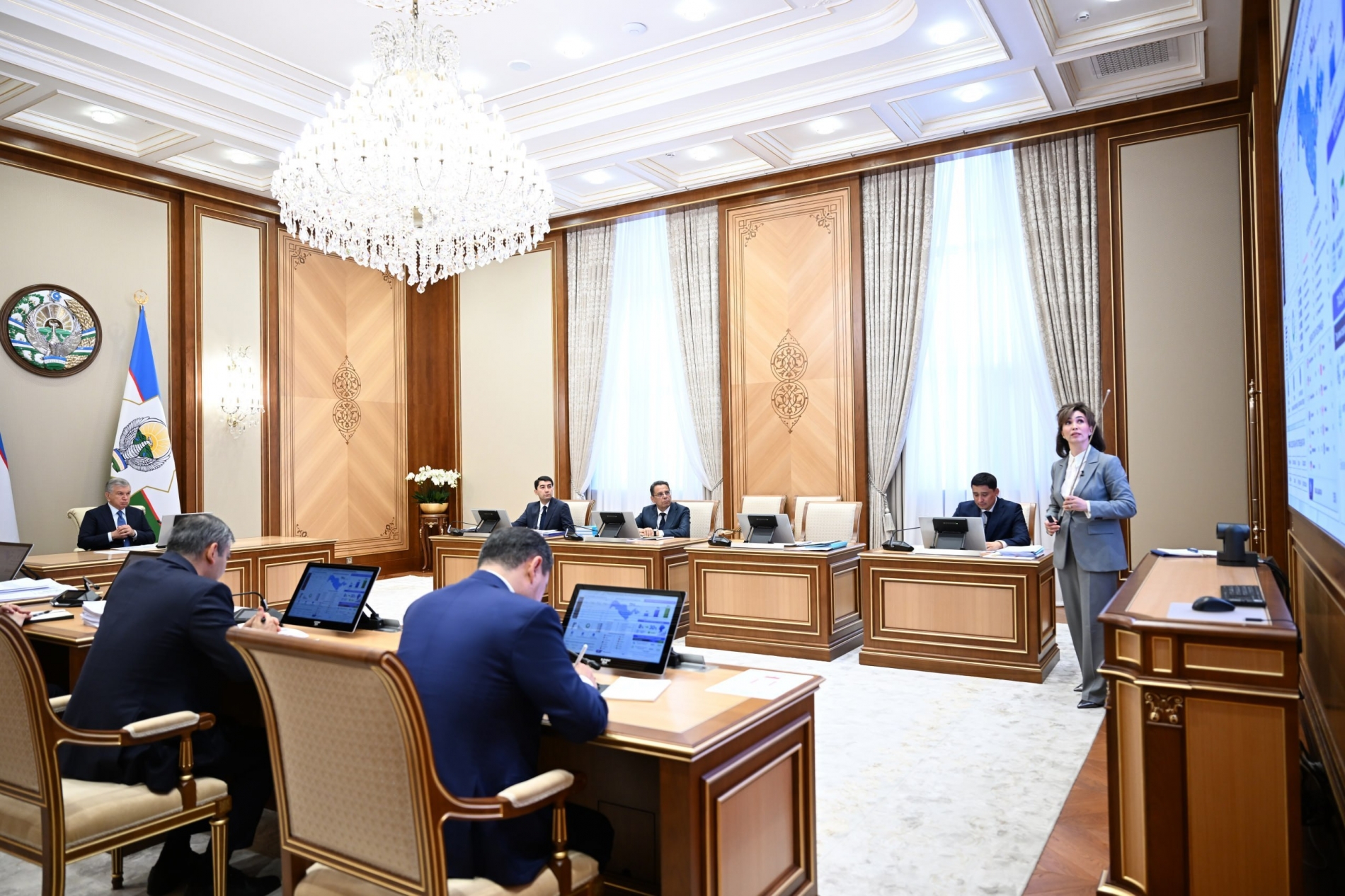
President Shavkat Mirziyoyev was briefed on measures to identify and select high-potential managers, leaders, and next-generation executives, as well as to support gifted young people through the El-Yurt Umidi Foundation.
Today, Uzbekistan is entering a new stage of development driven by intellectual potential and advanced technologies. Annual investment inflows exceed $50 billion, exports are approaching $40 billion, and modern enterprises are being commissioned across the country.
Against this backdrop, the proactive training of personnel needed for an effective public service and a competitive economy has become a strategic priority.
In recent years, the system for selecting and evaluating personnel in public administration has been consistently digitized. For the first time, a unified electronic database of 87.7 thousand civil servants has been created. Recruitment to the civil service is carried out through open competition, with candidates’ knowledge and skills assessed without human intervention.
During the presentation, it was noted that an analysis of growth areas across industries and regions, conducted using artificial intelligence, had identified a need for managerial personnel in more than 50 modern specializations. Particularly high demand for qualified specialists was noted in the fields of energy and green technologies, construction and urbanization, agriculture and water management, digitalization, and the service sector.
The Head of State emphasized that the lack of a well-prepared personnel reserve could lead to shortcomings in the management system, reduced operational efficiency, and lower-quality decision-making.
It was noted that the outdated method of evaluating personnel based on personal records should be abandoned in favor of a portfolio-based system that provides a comprehensive assessment of candidates, taking into account their knowledge, professional experience, psychological qualities, strategic thinking, and leadership abilities.
According to the new procedure, promising managers will be evaluated on a 100-point scale using digital technologies. By analyzing big data and business intelligence tools, high-potential specialists will be identified, for whom individual professional development plans will be developed using artificial intelligence. This system is proposed to be initially implemented in the fields of agriculture, higher education, and construction.
The plan is to select 500 promising managers every two years, creating a reserve of 1,500 next-generation executives by 2030.
During the presentation, the mechanism for conducting the open TOP-100 competition was also presented. The competition is aimed at ensuring the transparent formation of a personnel reserve for leadership positions and will cover the agricultural sector, healthcare, entrepreneurship, the judicial and legal system, education, information technology, and artificial intelligence.
Candidates will undergo testing, comprehensive professional assessments, and interviews. Upon completing specialized training, the winners will be included in the national personnel reserve. Targeted measures will be taken to support their professional development and prepare them for appointment to leadership positions.
The importance of effectively utilizing the potential of compatriots living abroad, as well as young people who have graduated from or are studying at the world’s top 100 universities, in building the national personnel reserve was emphasized.
In this regard, a “Students Abroad” module is scheduled to be launched on the career.edu.uz platform starting October 1, 2026. Through the platform, young people studying abroad will be assigned to government agencies and private enterprises, enabling them to gain practical experience, engage with potential employers, and subsequently secure employment.
The meeting also addressed measures to further improve the activities of the El-Yurt Umidi Foundation. As a result of the Foundation’s transformation carried out last year, the share of scholarship recipients studying at the world’s top 100 universities increased from 30 to 80 percent. Following three competitions held under the new procedure over the past year, 447 gifted young people were awarded Foundation scholarships.
At the same time, the need to align the Foundation’s programs with the specific needs of regions and industries was noted. Proposals were put forward for the targeted training of gifted young people at foreign universities, co-financing tuition costs with major enterprises, and launching joint educational programs with leading foreign higher education institutions.
Plans were also considered to support scientific research, startups, and graduate initiatives through small grants aimed at advancing reforms, as well as to organize leadership programs for senior executives based on the experience of Singapore, Malaysia, the United Kingdom, and Japan.
The Head of State instructed responsible officials to ensure openness and objectivity in personnel selection, provide systematic support for talented specialists, and make effective use of their potential for the country’s development.