
In his address at the 72nd session of the United Nations General Assembly on 19 September 2017, President Shavkat Mirziyoyev, speaking about the Center for Islamic Civilization being established in Tashkent, emphasized that our sacred religion calls for goodness and peace, the preservation of true human values, and the pursuit of knowledge and enlightenment, and that there can be no compromise with those who associate it with violence and bloodshed.
Founded on these noble ideals and aspirations, the center will serve as a platform for the in-depth study and broad dissemination of our people’s three-thousand-year history, their creative potential, their great contribution to world civilization, as well as the rich cultural and educational heritage of our great ancestors.
In terms of its grandeur, scale, and scope, the Center for Islamic Civilization in Uzbekistan is among the largest complexes in the world dedicated to the study and promotion of history, culture, and Islamic civilization.
The complex has been built on the territory of the renowned Hazrat Imam ensemble in Tashkent, covering an area of 10 hectares. The building comprises three floors, extending 161 meters in length and 118 meters in width. The height of its dome reaches 65 meters, while the total usable area exceeds 42,000 square meters. These figures provide a basis for its inclusion in the Guinness World Records.
The architectural concept of the center was developed on the basis of the ideas and proposals of President Shavkat Mirziyoyev. Throughout the construction process, the Head of State repeatedly visited the complex, offering valuable recommendations and guidance for further improvement both its content and architectural design. In particular, during several visits in 2025 alone, the President gave important instructions on improving the exhibitions, infrastructure, as well as educational and scientific directions.
The building, constructed in line with ancient and national architectural traditions, can be accessed from four sides through four grand portals. These portals and the exterior arches are adorned with Qur’anic verses and hadiths reflecting the ideals of enlightenment, generosity, humanism, and respect for parents.
The underground level houses a dedicated children’s platform, a restoration and digital preservation laboratory, storage facilities for museum exhibits and rare manuscripts, a modern cafeteria, and museum service areas.
The first floor features a museum with an exhibition hall of approximately 8,350 square meters, as well as a conference hall with 550 seats. The second floor houses a library containing handwritten and lithographic sources, printed and electronic publications, reading rooms, and facilities for international organizations and scientific institutions.
During his visit to this complex of immense spiritual and educational significance, the President once again familiarized himself with the conditions created, the rich exhibitions, and newly introduced initiatives.
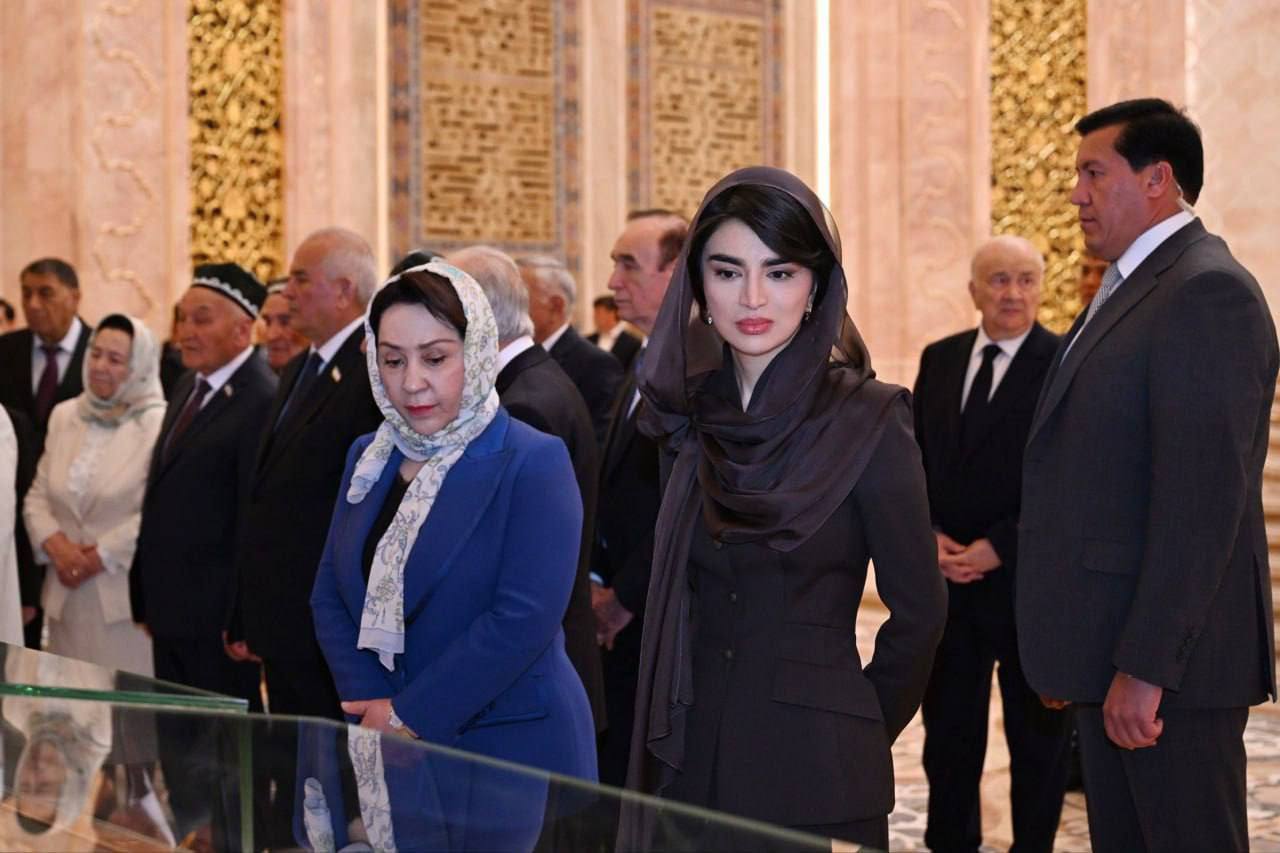
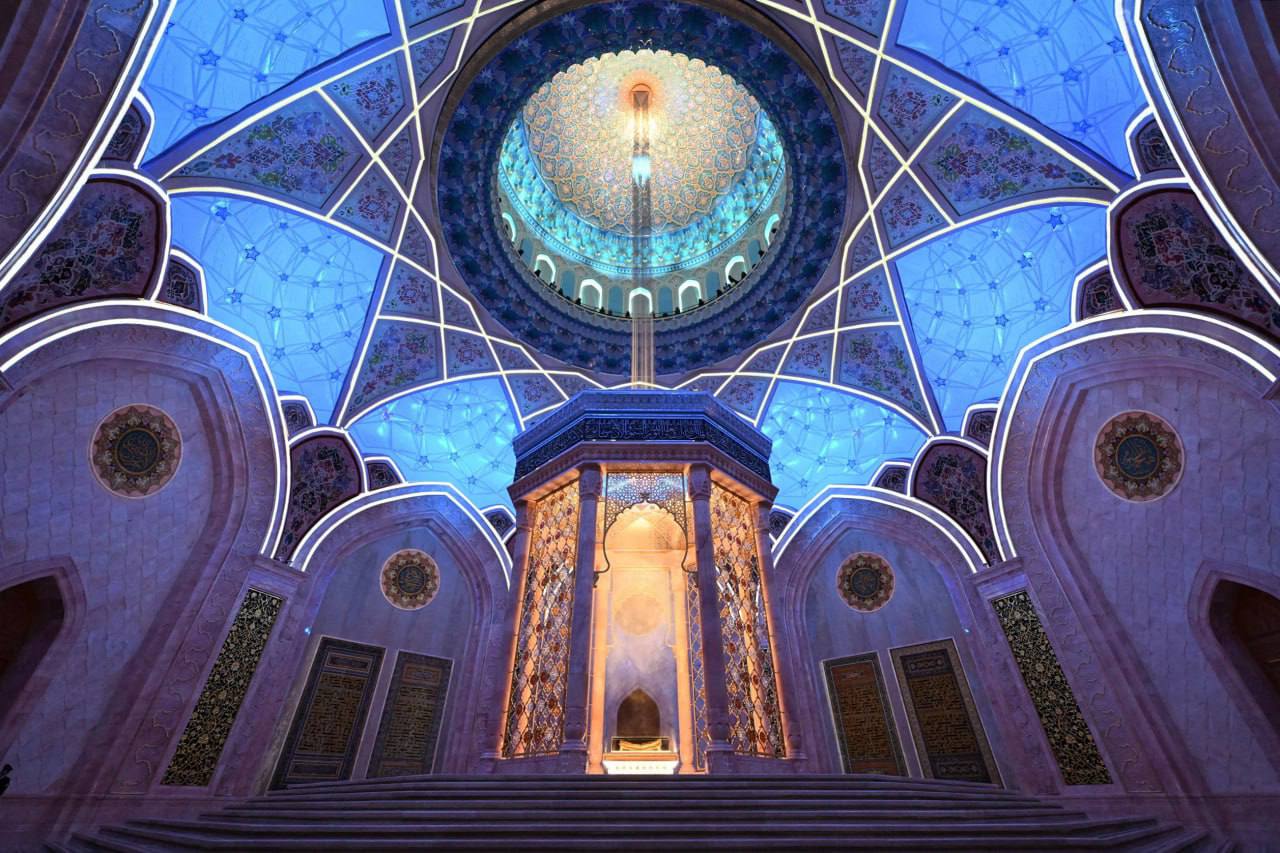
The Head of State first visited the Qur’an Hall, regarded as the spiritual heart of the Center, where he examined its unique environment and exhibits.
A special mapping hologram has been created beneath the dome, initially displaying a star-filled image of space. Notably, the composition of the stars reflects the night sky over Tashkent. Ninety Swarovski elements and over 650 light points have been used to recreate the stars, lending the hall a distinctive grandeur.
Displayed here, alongside the Mus’haf of Uthman, are 114 rare Qur’an manuscripts from various historical dynasties, including the Samanid, Karakhanid, Ghaznavid, Timurid, and Shaybanid periods. These works hold not only religious significance but also exceptional historical, scientific, and artistic value as outstanding examples of Eastern manuscript art. The hall’s modern display cases prominently feature original manuscripts that have been carefully preserved by the people and subsequently incorporated into the Center’s collection.
As noted, from the laying of the Center’s foundation to 2025, its collection grew to over 2,000 historical sources, including more than 60 rare Qur’an manuscripts. These were carefully preserved and contributed by compatriots, as well as acquired through international auctions. This work demonstrates a strong commitment to reviving national and religious heritage, returning priceless sources scattered across the world to the Motherland, integrating them into scholarly discourse, and preserving them for future generations.
The President was briefed on a number of particularly valuable manuscripts. Among them is the “Bozuband” Qur’an, created by the calligrapher Sultan Muhammad in 1589 in an octagonal form and used as a “tumar” (amulet), alongside an exquisite 17th-century Safavid-era copy reflecting the peak of calligraphy and book art. Also presented was a rare Maghribi-script manuscript produced in 1872 by Muhammad ibn Abd al-Hadi. A unique Seljuk-period copy dating from the 12th–13th centuries, prepared in the Naskh style with an interlinear Persian translation by Muhammad Sodiq ibn Muhammad Shafi, was also displayed. The traditions of the Samarkand, Herat, and Bukhara schools of calligraphy are clearly reflected in these works.
The President then reviewed a presentation on efforts to ensure high-quality services for museum visitors.
It was noted that the Center has quickly gained recognition from leading international organizations and publications. In particular, it was awarded the French Avicenna Prize and listed among the world’s ten most anticipated museum openings of 2026 by Smithsonian Magazine. In addition, Condé Nast Traveler included it in its list of museums to visit in June 2026, while BBC Travel ranked it among the world’s most anticipated museums.
Handouts, brochures, and publications have been prepared for visitors at the Center in accordance with international service standards. For the first time in Uzbekistan’s museum practice, the chemical composition and dating of all exhibits have been determined in a modern laboratory with the involvement of international experts, and the technical passports have been prepared for each item.
The exhibits have been digitized in accordance with international ISO standards and placed on a unified electronic platform. Based on the requirements of UNESCO and ICOM, as well as the experience of leading world museums, standards and classifications for exhibit labeling have been developed in 8 areas. Thanks to QR codes placed on each exhibit, visitors can use their mobile phones or tablets to access its video and audio content, initially in three languages, and later in eight.
The presentation paid special attention to transforming the center into a social integration platform based on the “A Museum Open to Everyone” concept. In the future, it is planned to equip all exhibits with special electronic chips and introduce an automated audio guide system for visually impaired visitors, enabling them to receive information about an exhibit as they approach it. It is also planned to implement an indoor navigation system using Bluetooth beacons, allowing for independent navigation within the building.
The use of robot guides, tablets for video and audio introductions, as well as audio guides, radio guides, and directional headphones, similar to those used in the British Museum, the Louvre, and the Metropolitan Museum of Art, is also planned.
It was noted that, according to preliminary estimates, the center is expected to receive an average of around 5,000 visitors per day. For the full operation of the center and museum in line with international standards, more than 400 employees are required. At present, over 100 specially trained attendants and more than 30 tour guides are employed. Separate guide scripts have been developed for visitors from 10 countries.
Afterwards, the Head of State reviewed the conditions created on the second floor of the Center’s building for the activities of the Muslim Board of Uzbekistan.
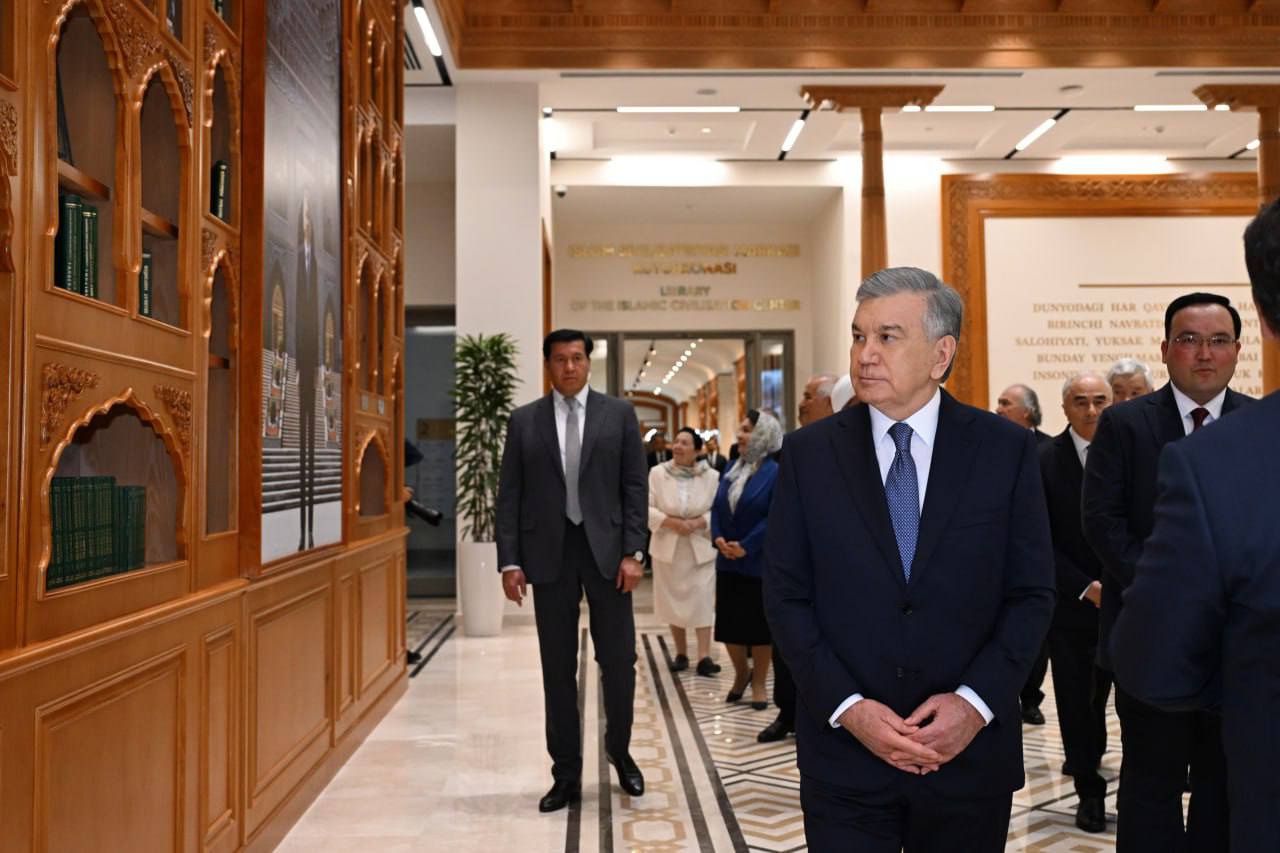
Continuing his visit, the President toured the Center’s library.
The total area of the library is 3,105 square meters. Its collection currently comprises more than 45,150 publications, including 2,609 rare volumes. In addition, the library holds over 350,000 electronic publications. It has the capacity to serve up to 310 users simultaneously. Four separate offices have been established for scholars and professors, equipped with all the modern technology and amenities necessary for conducting research.
One of the library’s departments is dedicated to the legacy of 22 Jadid enlighteners. It features their photographic portraits, while the bookshelves house unique works authored by them and publications devoted to their activities.
Furthermore, a series of measures are being taken to replenish the library’s collection with rare publications on the life and work of outstanding thinkers and scholars of Uzbekistan, as well as the scientific schools they founded. In particular, the collection includes first editions of manuscripts and lithographic works by great scholars, along with rare studies and commentaries devoted to their scientific heritage. This work is ongoing, with acquisitions from foreign auctions, scientific institutions, private collections, and donations from compatriots.
The library also features unique European publications, including works in Latin on Muslim dynasties, the history of Turkic peoples, encyclopedias on the peoples of the East, and travelogues on Khorasan and Mawarannahr published prior to the 20th century. In addition, the collection has been enriched with rare sources acquired from private collections, such as Nasuriddin Rabguzi’s “Qisas ul-Anbiya,” diwans of Alisher Navoi transcribed in Tashkent in the early 19th century, and Turkic translations of the works of Mawlana Jalaluddin Rumi.
Information was also presented on the creation of special conditions for users with disabilities. In particular, dedicated rooms have been established for visually impaired and blind individuals, equipped with specialized software, printers, and assistive devices, and more than one thousand publications in Braille have been introduced. Notably, for the first time in Uzbekistan, soundproof booths have been installed in the library, enabling users to conduct online conversations without disturbing others while ensuring the confidentiality of their conversations and personal data. Furthermore, the modern Sonic Chair device for working with audio resources has been introduced for the first time not only in the country but across Central Asia.
On the library’s premises, a green reading zone, a copying service, dedicated rooms for individual study, and a separate area for children have been organized.
The President then familiarized himself with the activities of the international scientific and educational platform established at the Center.
As noted, cooperation has been established with a number of reputable international organizations within the framework of the platform. Office spaces have been provided for ICESCO, IRCICA, the Oxford Centre for Islamic Studies, the Association of Timurids in France, TURKSOY, and other international organizations. This creates a favorable environment for domestic scholars and representatives of foreign institutions to collaborate, conduct joint research, develop projects, and implement educational initiatives.
During the visit, the Head of State viewed an exhibition of valuable artefacts donated to the Center and acquired from abroad.
As noted, in accordance with the President’s instructions, systematic work is being carried out to repatriate cultural treasures located abroad to Uzbekistan. Last year, more than 700 artefacts were acquired from art dealers and private collectors at auctions in the United Kingdom, including Sotheby’s and Christie’s. In addition, over 1,000 items were donated by various institutions, organizations, and patrons. The majority of these exhibits are housed in the museum on the first floor.
The exhibition features numerous rare artefacts from the Samanid, Karakhanid, Ghaznavid, Timurid, and other eras. Particularly noteworthy are a silver barkash (tray) with gold plating bearing the name of the Samanid commander Abu Mansur Sebük-Tegin, dating from the late 10th century, a silver bowl and a copper inkwell from the Samanid period, a woman’s belt adorned with turquoise from the reign of Öz Beg Khan of the Golden Horde, and 19th-century Ottoman gold-thread embroidery bearing the inscriptions “Allah” and “Muhammad.”
The President was presented with information on examples of ceramic art from the Timurid era, a 19th-century silk covering that veiled the Prophet’s tomb in Medina, and a historical example of a hizam (the belt at the top of the kiswah) that once hung above the door of the Kaaba, as well as a large-scale “mother of all suzanis.” Additionally, fragments of a large Qur’an transcribed by Umar Aqta during the time of Amir Timur were displayed, along with ceramic tile elements from Timurid architectural monuments, as well as weapons and armor from the Baburid period, including helmets, shields, swords, and armor components.
Furthermore, a report was presented on finds related to the Amu Darya Treasure. In 1877, a number of unique items from this treasure, discovered in the territory of the Emirate of Bukhara and now housed in the British Museum, were successfully returned to Uzbekistan through London trading houses. Among them are a gold pectoral depicting a Sogdian horseman from the 8th–9th centuries, as well as unique snake-shaped bracelets weighing 666 grams, dating back to the Bactrian era.
A significant part of the exhibition is devoted to artefacts donated to the Center. Notably, Alexander Naymark, an Orientalist based in the United States, donated a manuscript of Pahlavon Mahmud. Transcribed from the personal signature of the Khivan Khan Muhammad Rahimkhan Feruz, its study resulted in the discovery of more than 70 previously unknown rubais. The exhibition also includes coins, jewelry, medallions, and other historical items from various periods, including finds from the hoard discovered in the Mayskiy settlement.
Overall, the visit once again vividly demonstrated the immense potential of the Center. It enables a deeper understanding of the country’s history and cultural heritage, reveals the true humanistic and enlightening essence of Islam, and presents the great scientific and spiritual legacy of our ancestors to the international community.
“Today, we have witnessed a significant event on the path to understanding our identity. Praise be to the Almighty that over the past nine years, through dedication, hard work, and perseverance, we have created a complex that truly reflects who we are, who our people are, and what our history represents. Everyone who comes here, especially our youth, should know and understand the greatness of the ancestors from whom we descend.
This large-scale project is not merely a design or a structure. It was created from the heart, born of love, dreams, and the deepest aspirations. The sacred hall where the Qur’an will be kept did not come into being by chance. It emerged from the heart, from a desire to reflect the dreams of our people, their greatness, and their spiritual strength. This project is the result of noble aspirations aimed at embodying the true image of our great people,” said the President.
At the conclusion of the visit, the Head of State signed the Book of Honored Guests of the Center for Islamic Civilization.