
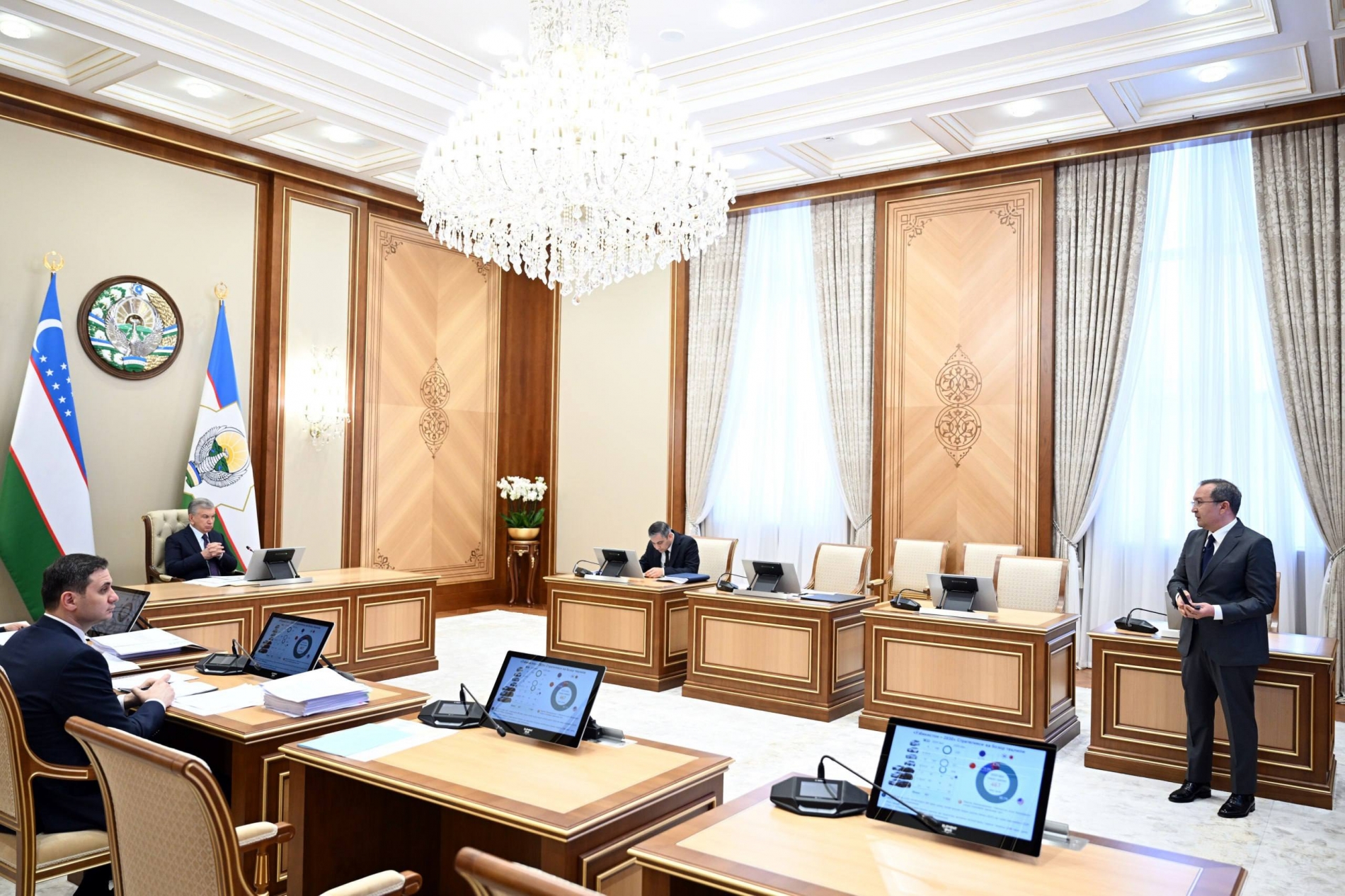
President Shavkat Mirziyoyev reviewed proposals to develop the automotive industry, expand production capacities, and enhance the sector’s competitiveness.
Special attention to the development of the automotive industry in the country is well justified. The sector plays an important role in creating high added value, developing industrial cooperation, creating thousands of jobs, and expanding export opportunities.
In recent years, Uzbekistan’s automotive industry has entered a completely new stage of development focused on competition and consumer interests. Whereas a decade ago the automotive market was associated with a single manufacturer and long queues, today five automobile plants operate in cooperation with major brands such as Chevrolet, BYD, KIA, and Hyundai. This year also envisages the launch of Volkswagen, Foton, and JAC plants.
Most importantly, the population directly feels these changes. The range of products on the market has expanded, while the long queues have disappeared. This year, 20 banks have been involved in financing car purchases, resulting in 95 percent of vehicles being sold through installment plans and an accessible credit system.
At the same time, the production of automobiles and components aimed at the markets of neighboring countries is developing. New cooperation chains are forming around the industry, with more than 10,000 young specialists working with modern technologies. Over 300 enterprises supply components for Chevrolet, while around 40 enterprises supply components for KIA and BYD.
During the presentation, progress toward reaching the 1 million mark in the automotive industry in both production volume and employment was reviewed.
The large number of project proposals for the production and assembly of passenger and commercial vehicles indicates that a favorable investment climate and a highly liquid market are taking shape in Uzbekistan. At the same time, it was emphasized that each project must be evaluated in terms of market demand and economic efficiency, with the main focus placed on ensuring competitiveness in foreign markets.
The presentation also included information on the Volkswagen vehicle production project. According to the plan, the first stage involves launching large-scale assembly operations in Tashkent. The next stage will focus on establishing a full production cycle in the Angren Free Economic Zone, increasing the level of localization, and entering foreign markets.
The current global situation was said to be having a significant impact on the automotive industry. In this regard, particular attention was given to ensuring technological independence, introducing innovations, and developing a competitive national product less dependent on export and logistical constraints.
It was noted that modern engineering schools have been established in Andijan and Jizzakh, where a new generation of young researchers and engineers is emerging, and that the country possesses the necessary intellectual potential to develop a domestic automotive brand.
To this end, a decision was made to expand research and development activities within the Uzavtosanoat JSC system.
The auto components market was identified as another major opportunity for the industry.
In this regard, particular attention was given to regulating the components market, increasing the share of locally produced goods, improving the certification system, and establishing modern testing laboratories. A task was set to develop, by the end of 2026 and with the involvement of international consulting companies, a strategy for the development of the automotive spare parts market.
The President stressed that the automotive industry is one of the strategic sectors of the national economy and issued specific instructions on strengthening competition, deepening localization, and developing a national engineering school within the industry.