
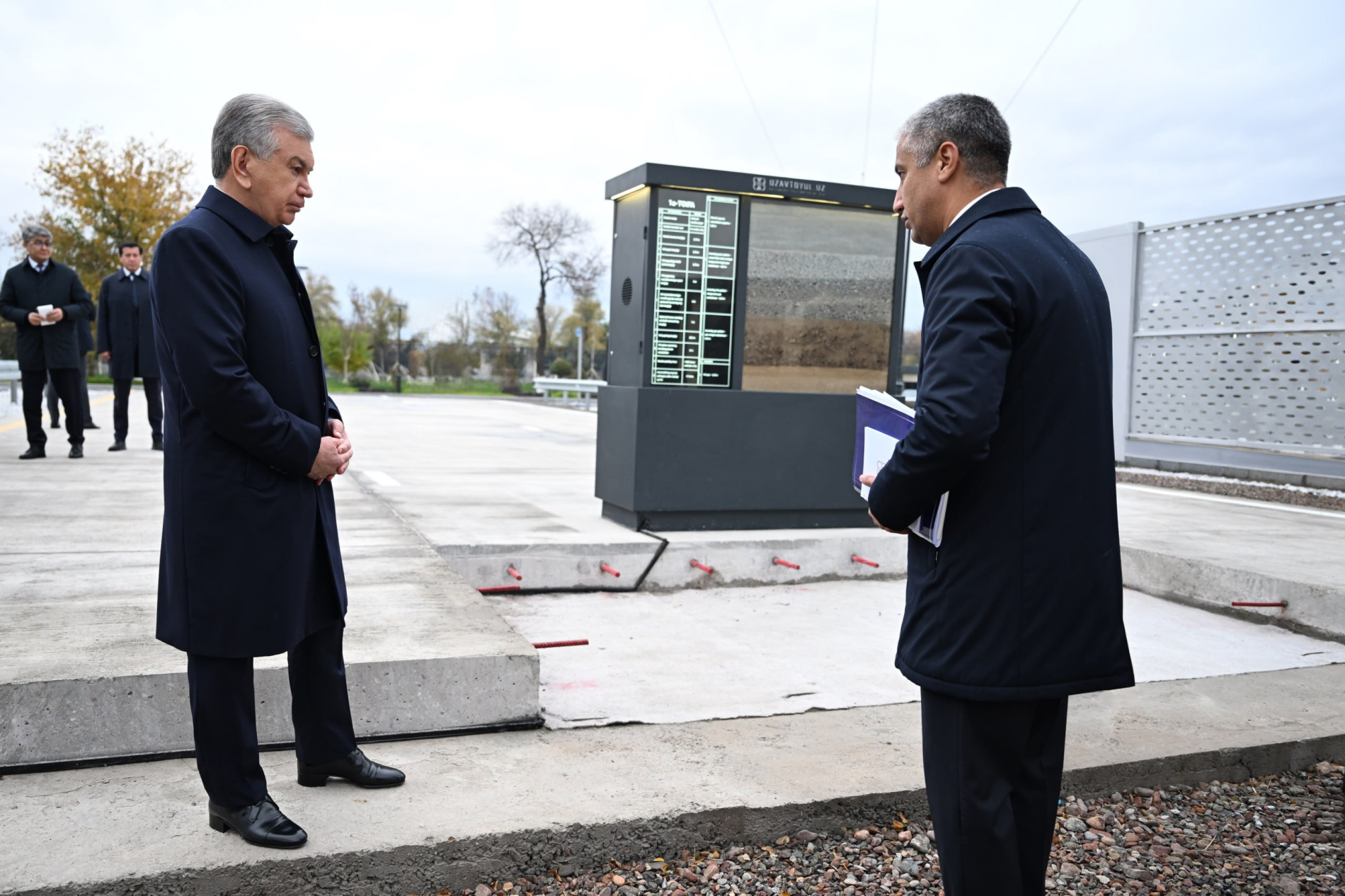
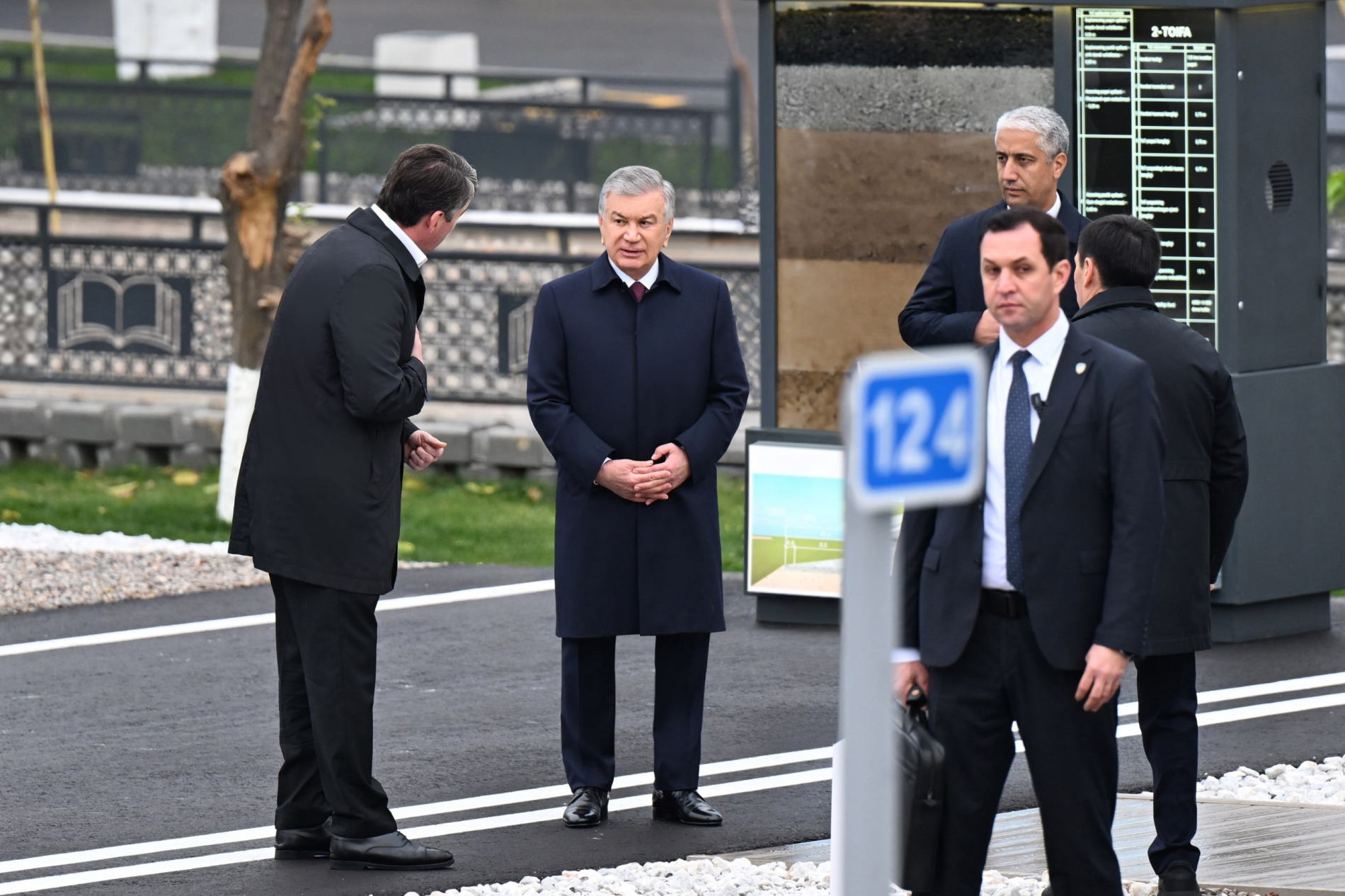
Today, President Shavkat Mirziyoyev visited the scientific and practical center of the Road Committee and learned about its work and facilities.
In recent years, Uzbekistan has placed a strong emphasis on integrating research findings and advanced practices into education, as well as training qualified professionals equipped with modern knowledge and skills for various sectors of the economy.
The scientific and practical center of the Road Committee was established to serve these purposes. Its activities focus on advancing scientific research in the road sector, introducing modern technologies, and training a new generation of engineers. The complex covers 2.7 hectares and has created 80 permanent jobs.
The center’s training ground features full-scale road structures and key components of road infrastructure. Here, specialists and students can gain hands-on experience by studying the design and functions of pavement layers, road signs, safety barriers, drainage systems, bridges, and culverts.
The training ground demonstrates the geometric characteristics of highways in technical categories I through V, along with their corresponding road surfaces made of cement concrete, hot and cold asphalt concrete, gravel, and crushed stone. In total, the facility features 75 types of road infrastructure components.
The complex also houses a specialized fleet of equipment, including road construction machinery, a mobile laboratory for pavement diagnostics, and vehicles equipped with AI-based monitoring and weighing systems. The facility provides opportunities to study how modern equipment operates and how it is maintained.
The Situation Center, which is part of the complex, uses a unified digital system to collect and analyze data on the technical condition of highways, traffic flow, weather conditions, and the progress of road construction and repair work.
The center is integrated with seven of the committee’s information systems. Its capabilities include assessing the technical condition of 42,400 kilometers of highways using the RAMS system, analyzing pavement conditions using artificial intelligence, weighing vehicles through the WIM system, tracking the movement of road construction equipment using GPS, and monitoring toll road payments online.
Currently, nine operators at the center monitor a 100-kilometer section of the A-373 international highway running through the Kamchik Pass in real time.
Integration with the information systems of relevant ministries and agencies enables the center to automatically analyze road conditions, identify potential risks in advance, and issue timely alerts.
To enhance the professional skills of specialists and reinforce students’ theoretical knowledge, the center houses a scientific library and three classrooms equipped with interactive learning tools.
Three modern laboratories for testing and conducting research on road construction materials have also begun operations. The laboratories study the properties of asphalt concrete, cement concrete, aggregates, and bitumen. Currently, 15 scientists and five researchers conduct research at the facility.
The President also toured the Highway of Time Museum located within the complex.
The museum features 107 exhibits showcasing the origins and development of Uzbekistan’s road sector, as well as construction materials, technologies, and unique engineering solutions used during different historical periods.
The museum also houses examples of road construction machinery from the last century. Using interactive screens, visitors can learn about the history and purpose of these machines in three languages.
The Head of State emphasized the importance of making effective use of the center’s capabilities to train qualified engineers and road management specialists, direct scientific research toward solving practical problems facing the industry, and promote the widespread adoption of modern technologies to improve the quality of road construction and the efficiency of highway operations.
There, the President also spoke with foreign investors involved in implementing major road infrastructure projects.